 Pyramid of Giza Tours
Home › Guides › Giza Pyramids Facts: How Old, How Tall and Who Built Them
Giza Pyramids Facts: How Old, How Tall and Who Built Them
The most common wrong belief is that slaves dragged every block, but the Giza Pyramids facts show they were built over 4,500 years ago by paid, skilled workers, and the Great Pyramid was the tallest structure on Earth for about 3,800 years. Here are the numbers and the myths corrected, plus what they mean for your own pyramid of giza tour day.
Quick answer Age, height and builders of the Giza pyramids in seconds
The three Giza pyramids are royal tombs built between 2580 and 2500 BCE for the pharaohs Khufu, Khafre and Menkaure. The Great Pyramid originally stood 481 feet (146.6 meters) high and still rises about 454 feet (138.5 meters) today. Paid skilled workers built them, not slaves.
Key takeaways
- Pick a Giza Pyramids and Sphinx Private Tour with a Camel Ride from $54 per person
- Go inside on the Private Giza Pyramids Tour with Entry Inside the Great Pyramid from $15 per person
- Catch the sunrise on the Giza Pyramids Sunrise Tour with a Camel Ride and Breakfast from $67 per person
- Browse every pyramid of giza tour option in one place
Who built the pyramids of Giza?
Three 4th dynasty pharaohs built them: Khufu, Khafre and Menkaure.
Each of the three great pyramids is a royal tomb named after the king it was built for. Knowing which is which makes the plateau far easier to read on the day, since your guide will usually show you the biggest first.
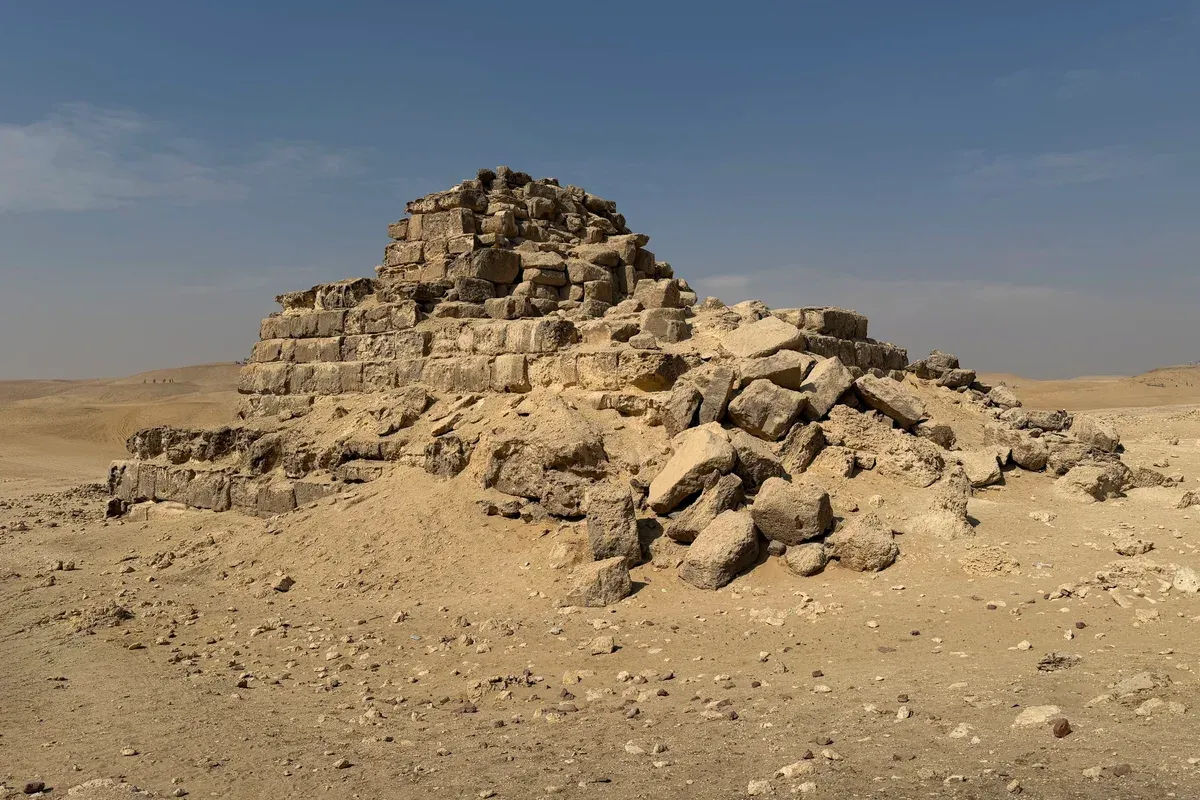
A ruined queen's pyramid beside Menkaure's pyramid. Photo: Quintin Soloviev, CC BY 4.0, via Wikimedia Commons
The three kings
The pyramids were royal tombs for Khufu, Khafre and Menkaure, kings of the 4th dynasty. The Great Pyramid belongs to Khufu, and it is the only surviving Wonder of the Ancient World. Khafre's pyramid looks the tallest from the road only because it sits on higher ground, which surprises most visitors.
The pyramids are only the towers. Each pyramid also had a mortuary temple linked by a causeway to a valley temple, plus smaller subsidiary pyramids for royal family members. On a Giza Pyramids and Sphinx Private Tour with a Camel Ride your guide walks you past these remains, which most day visitors rush straight past.
| Pyramid | Built for | Base side | Original height |
|---|---|---|---|
| Great Pyramid | Khufu | 755.6 feet (230.3 meters) | 481 feet (146.6 meters) |
| Second pyramid | Khafre | 707.75 feet (216 meters) | 471 feet (143 meters) |
| Third pyramid | Menkaure | 356.5 feet (109 meters) | 213 feet (65 meters) |
How old are the pyramids?
They are over 4,500 years old, built between 2580 and 2500 BCE.
The age is one of the facts that makes the site hard to take in at first. The structure in front of you was already ancient when Tutankhamun was a king.
The timeline
The pyramids were built between 2580 and 2500 BCE, so they are over 4,500 years old. The Great Pyramid dates to about 2600 BC and took about 26 years to build, though Herodotus recorded 20 years. For scale, the pyramid fields from Giza to Dahshur were inscribed on the UNESCO World Heritage List in 1979, a listing that covers the whole necropolis you visit.
Age also explains the morning routine. The plateau is open every day from 07:00 with last entry at 16:00. The first hours are the coolest and the emptiest, which is exactly why the Giza Pyramids Sunrise Tour with a Camel Ride and Breakfast starts so early.
Sources: UNESCO World Heritage Centre, Egyptian Monuments Authority.
How tall is the Great Pyramid?
It was 481 feet (146.6 meters) high when new and stands about 454 feet (138.5 meters) today.
The pyramids lost their smooth outer skin over the centuries, so the heights you see today are lower than the builders aimed for.
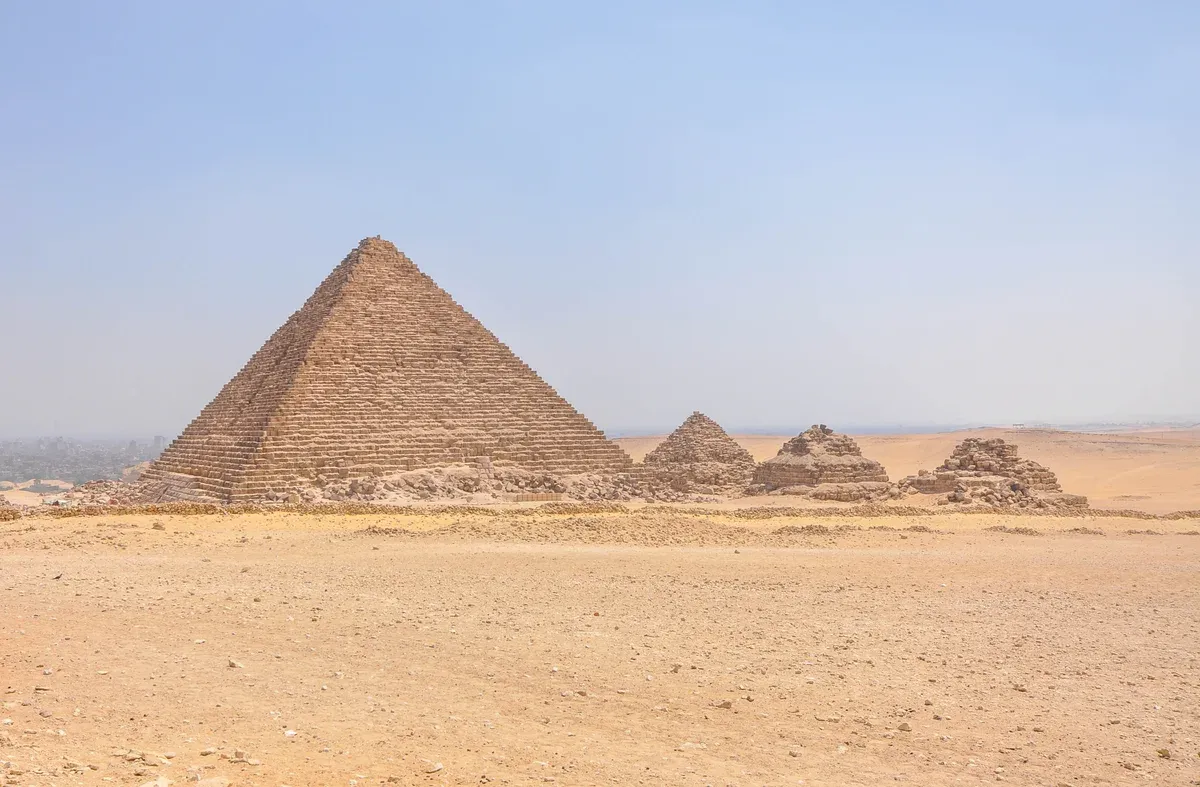
Menkaure's pyramid and its satellite pyramids. Photo: Jorge Láscar from Melbourne, Australia, CC BY 2.0, via Wikimedia Commons
Original versus today
The Great Pyramid originally reached 146.6 meters and now stands at about 138.5 meters after its limestone casing was removed. Khafre's pyramid keeps its outer casing only at the top, which is why it still looks sharply pointed from a distance. Menkaure was 213 feet (65 meters) high when complete.
For nearly four millennia the height record stood firm. The Great Pyramid was the tallest man-made structure on Earth for about 3,800 years, until the 19th century. When you stand at its base on a Private Giza Pyramids Tour with Entry Inside the Great Pyramid, you are looking at a stone mass of 5.9 million tonnes.
| Pyramid | Original height | Height today |
|---|---|---|
| Great Pyramid (Khufu) | 481 feet (146.6 meters) | about 454 feet (138.5 meters) |
| Khafre | 471 feet (143 meters) | 447 feet (136.4 meters) |
| Menkaure | 213 feet (65 meters) | not stated |
Did slaves build the pyramids?
No, the builders were skilled workers, not slaves, who lived in purpose-built villages and were fed and paid.
This is the biggest myth on the whole plateau, and your guide will probably correct it within the first ten minutes.
What the evidence shows
Archaeology points to a permanent workforce of as few as 20,000 workers plus support staff, not the 100,000 men that Herodotus recorded. The builders were skilled workers who lived in purpose-built villages, were fed and were paid. The most plausible method was a sloping encircling ramp of brick, earth and sand, with sledges, rollers and levers moving the blocks.
One more mystery survives. Scientists cannot identify the exact recipe of the mortar holding the blocks together. You can hear the full workforce story, backed by the excavated workers' village, on the Giza Pyramids, Sphinx, Saqqara and Memphis Day Tour from Cairo, where the Labor Tombs add-on covers the builders' own burial ground.
What is inside the pyramids, and can you go in?
Inside are burial chambers, narrow passageways and stone coffers, and yes, you can enter for a separate add-on fee.
The interiors are plainer than most visitors expect, and that is itself one of the strangest facts about the site.
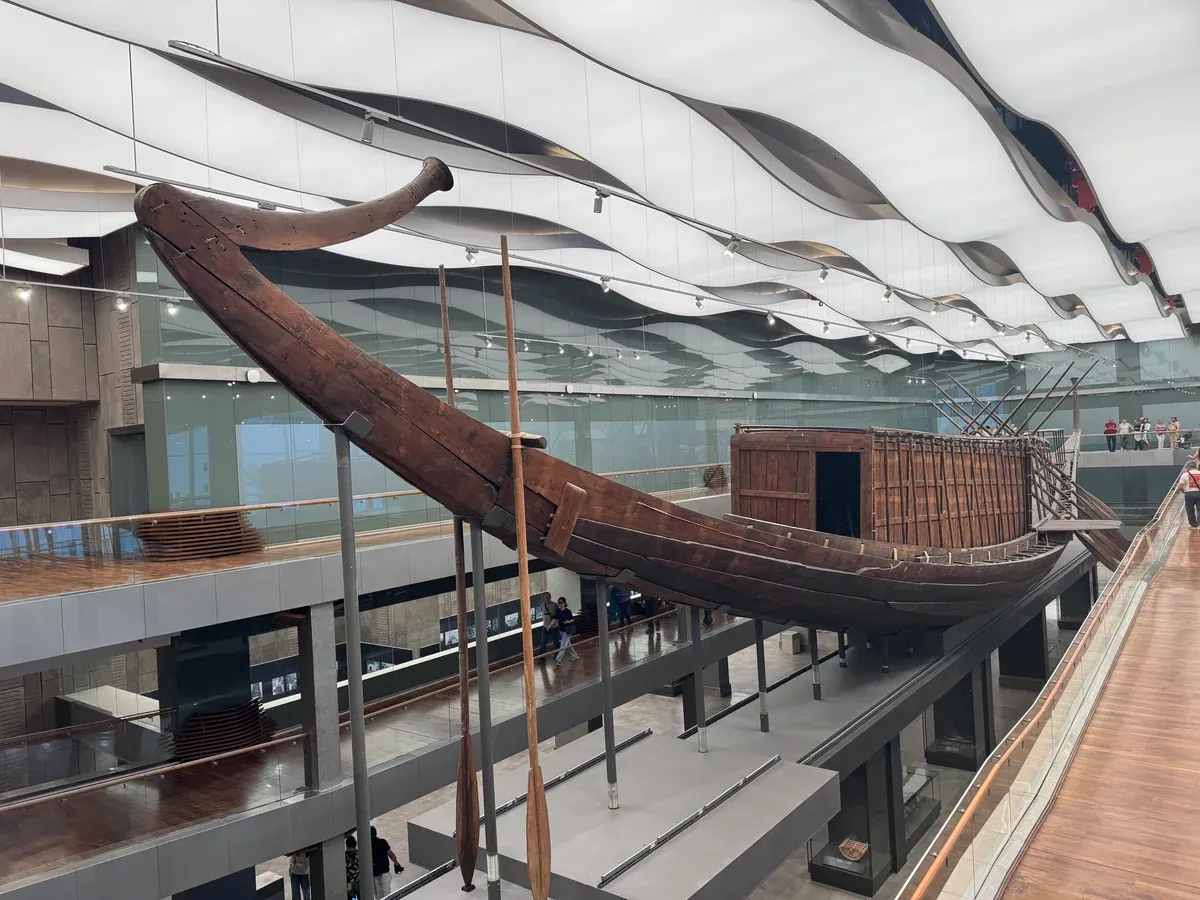
Khufu's solar boat on display at the Grand Egyptian Museum. Photo: Alena Belova for Exhibo, CC BY-SA 4.0, via Wikimedia Commons
Empty tombs
No hieroglyphic texts, treasures or mummies have been found in any of the Giza pyramids. What you find inside are burial chambers, narrow passageways and stone coffers. The famous Tutankhamun treasures now live at the Grand Egyptian Museum instead, which you can combine with the pyramids on the Giza Pyramids, Sphinx and Grand Egyptian Museum Tour with Lunch at $97 per person.
Entering the pyramids is priced separately from the plateau ticket. The Ministry of Tourism and Antiquities lists entry inside the Great Pyramid of Khufu at EGP 1,500 (about $27.09) for a foreign adult and EGP 750 (about $13.55) for a foreign student, while Khafre's pyramid costs EGP 280 (about $5.06) for a foreign adult. The Private Giza Pyramids Tour with Entry Inside the Great Pyramid is from $15 per person and takes care of the arrangements.
| Add-on | Foreign adult | Foreign student |
|---|---|---|
| Inside the Great Pyramid (Khufu) | EGP 1,500 (about $27.09) | EGP 750 (about $13.55) |
| Inside Khafre's pyramid | EGP 280 (about $5.06) | EGP 140 (about $2.53) |
| Meresankh III tomb | EGP 200 (about $3.61) | EGP 100 (about $1.81) |
| Giza Plateau entry | EGP 700 (about $12.64) | EGP 350 (about $6.32) |
Sources: Egyptian Monuments Authority, Egyptian Monuments Authority.
What are the mathematical facts about the Great Pyramid?
Its base covers over 13 acres, its sides rise at 51 degrees 52 minutes and its mass is 5.9 million tonnes.
The numbers behind the shape are what turn a photo stop into a long stare.
Angle, area and mass
The base covered over 13 acres, and each side is over 755 feet long, with sides rising at an angle of 51 degrees 52 minutes. The Great Pyramid alone has a mass of 5.9 million tonnes. Each side of the base measures about 230.3 meters, and the sides are aligned with striking precision toward the compass points.
Why a pyramid at all? Theories on the shape include a stairway for the pharaoh's ka, a recreation of the ancient mound of creation, or sunrays reaching the earth. Your guide on any pyramid of giza tour will give you their take as you look up the face of the structure.
Why did Muslims not destroy the pyramids?
One ruler did try.
The question comes up because one medieval ruler genuinely made the attempt, and failed.
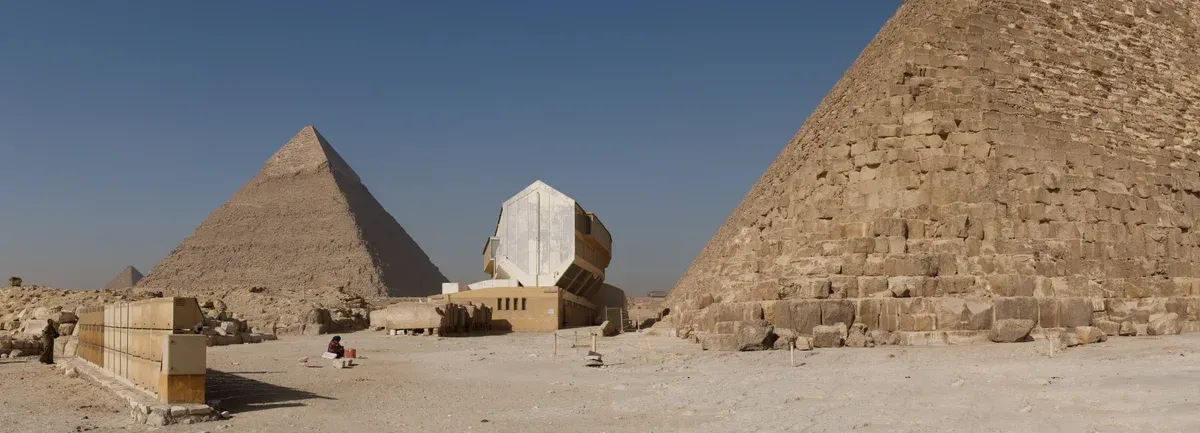
The solar boat museum beside the Great Pyramid. Photo: kallerna, CC BY-SA 3.0, via Wikimedia Commons
The 12th century attempt
Sultan Al-Aziz Uthman tried for months to take the pyramids apart and eventually gave up, and his work left scars that you can still see on Menkaure, the smallest of the three. The pyramids were simply too massive and too expensive to dismantle block by block. Later Muslim rulers treated Giza as a wonder rather than a threat, which is why the monuments survived intact into the modern era, and into the UNESCO World Heritage List.
Source: UNESCO World Heritage Centre.
What are 5 interesting facts about the Great Pyramid of Giza?
It is the last surviving ancient Wonder, it held the height record for 3,800 years, it is empty inside, paid workers built it, and its mortar recipe is still unknown.
If you want the short version to share on the way back to the hotel, these five facts cover it.
The five-fact list
1. It is the only surviving Wonder of the Ancient World, built for Pharaoh Khufu.
2. It was the tallest man-made structure on Earth for about 3,800 years, until the 19th century.
3. No hieroglyphic texts, treasures or mummies have been found in it.
4. Skilled paid workers built it, not slaves, from a workforce of about 20,000.
5. Scientists still cannot identify the exact mortar recipe holding its blocks together.
These five facts work as a compact story for a visit, and they also cover most of what children ask. Kids tend to latch onto the height record and the empty tomb, so lead with those on a family Giza Pyramids and Sphinx Private Tour with a Camel Ride.
Tours That Fit
Turn the facts into a morning on the plateau with one of these.
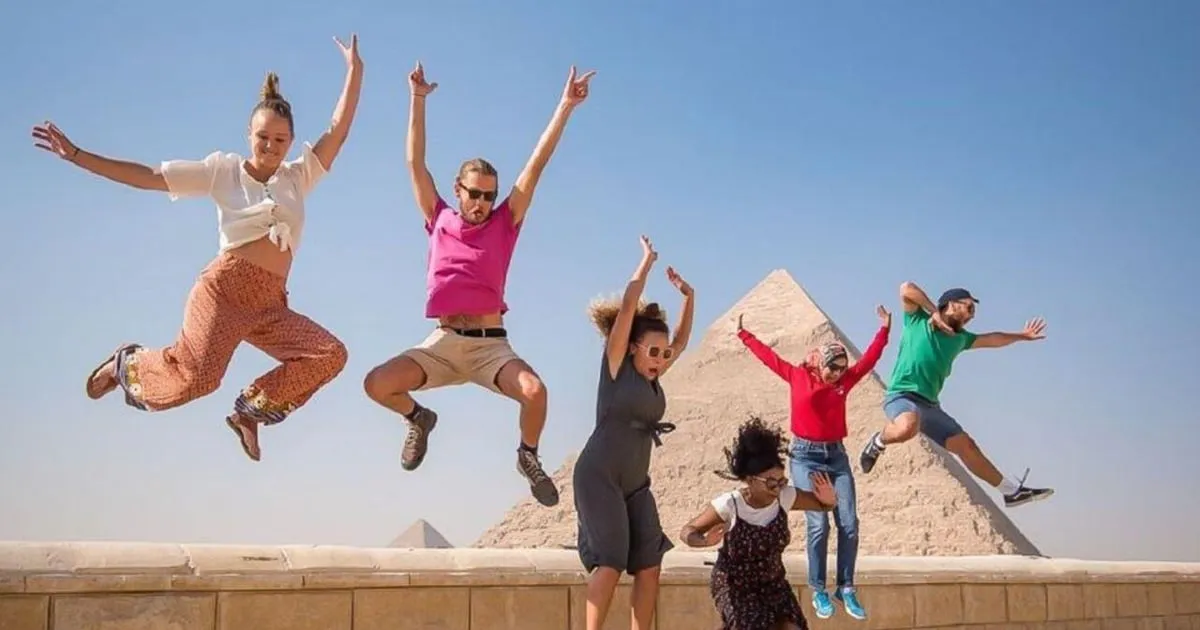
Giza Pyramids and Sphinx Private Tour with a Camel Ride
The classic half day, private: your own car, an Egyptologist, the plateau ticket already paid and a camel ride at the panorama point. Two shop stops are part of the day.
- Category
- Half day at Giza
- Cancellation
- Free cancellation 24h
- Operator
- Snefro Travel
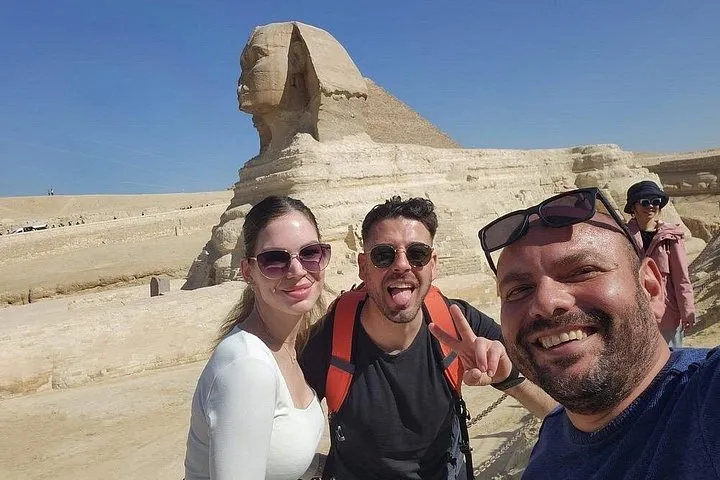
Private Giza Pyramids Tour with Entry Inside the Great Pyramid
The listing price is car and guide only. The option that takes you inside the Great Pyramid of Khufu, with the plateau ticket, lunch and a camel ride, is $100.
- Category
- Half day at Giza
- Cancellation
- Free cancellation 24h
- Operator
- A1 Egypt Private Day Tours
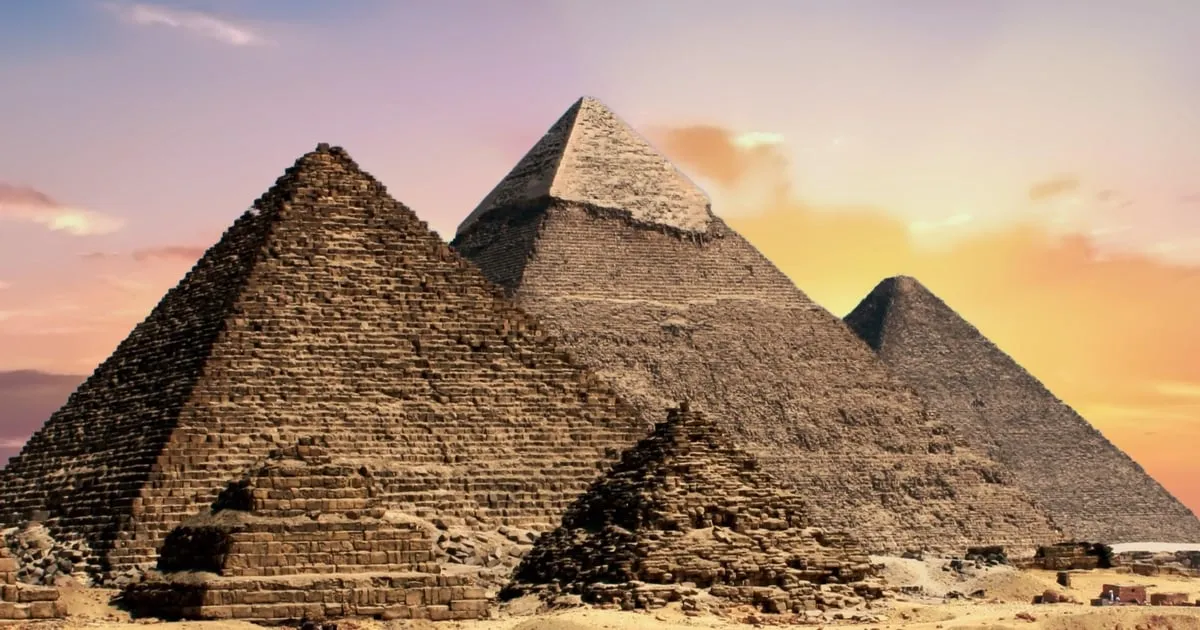
Giza Pyramids Sunrise Tour with a Camel Ride and Breakfast
A 5 am pickup and an hour on a camel or horse while the sun comes up behind the pyramids, then breakfast and two guided hours on the plateau before the heat.
- Category
- Half day at Giza
- Cancellation
- Free cancellation 24h
- Operator
- Egypt Excursions Online
Are the pyramids aligned with Orion's Belt?
The three great pyramids align with the stars of Orion's Belt, a pattern linked to the god Osiris.
This is the alignment that guides love to point out from the panorama point.
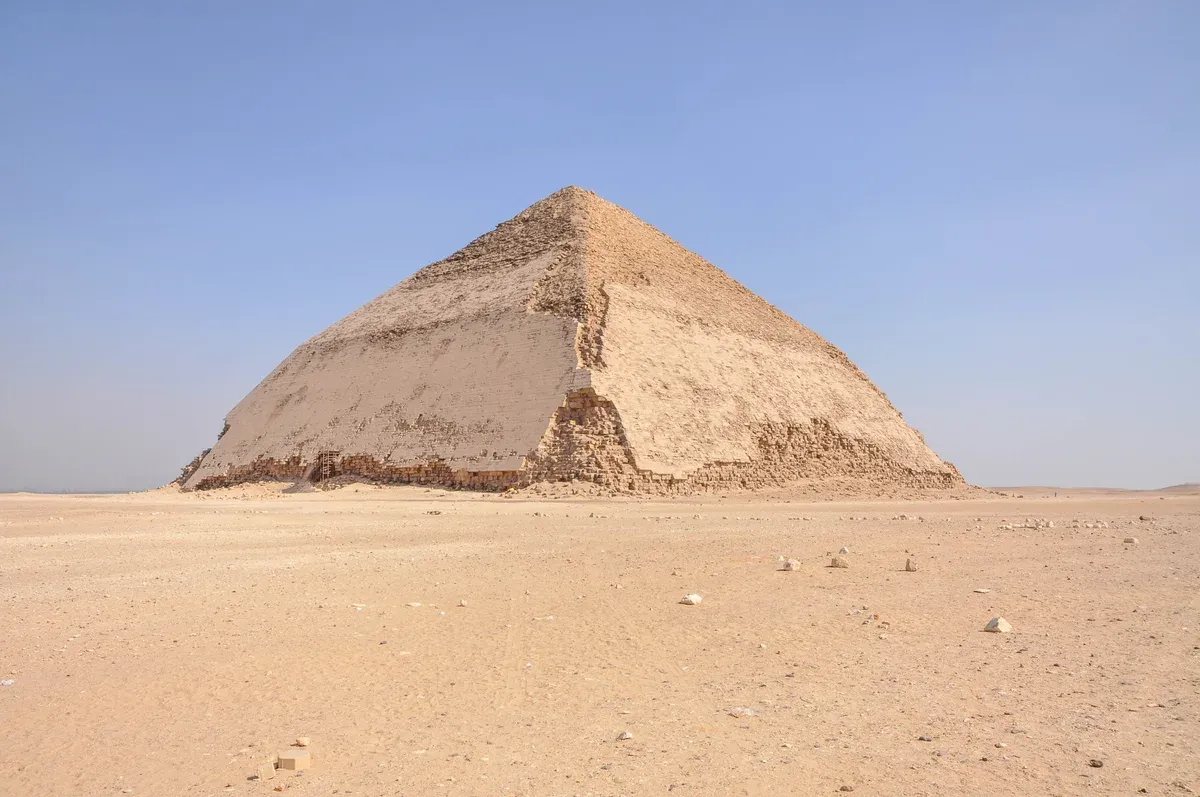
The Bent Pyramid keeps much of its original casing. Photo: Jorge Láscar from Melbourne, Australia, CC BY 2.0, via Wikimedia Commons
Stars and meaning
The layout of the three great pyramids matches the three stars of Orion's Belt, a constellation associated with Osiris. Whether the match was deliberate or coincidental is still argued, but the visual match from above is real. The shape theories, a stairway for the pharaoh's ka, the mound of creation, or sunrays reaching the earth, all point the same way: pyramids were machines for reaching the sky, which fits an Osiris link neatly.
For a different kind of alignment, the pyramids sit about 13 km southwest of central Cairo and about 9 km west of the Nile, close enough that you can see them from parts of the city on a clear day.
How many days do you need in Giza, and what should you know before going?
One full day covers the pyramids well, and the practical facts that matter are the 07:00 opening, the separate add-on tickets and the student rules.
Most travellers fit Giza into a single day from Cairo, and the plateau rules decide how that day runs.
Hours, tickets and rules
The Giza Plateau is open every day from 07:00, with last entry at 16:00 in both summer and winter schedules. During Ramadan it opens at 08:00 with last entry at 15:30. The site asks visitors to arrive at least one hour before closing and to keep their ticket for the whole visit. Plateau entry is EGP 700 (about $12.64) for foreign adults and EGP 350 (about $6.32) for foreign students, and children under 6 enter free.
Student tickets require a valid ID and the student must be 24 or younger. Tickets come from egymonuments.com, the official e-ticketing platform of the Ministry of Tourism and Antiquities, and they are non-refundable and cannot be replaced if lost. Visa and Mastercard are accepted at the counters, the app and the self-service kiosks. Photography with a mobile phone is free, but drones need a permit from the Egyptian Ministry of Defense, so leave the drone home.
If one day is not enough, Saqqara costs EGP 600 (about $10.84) for a foreign adult and opens at 08:00 with last entry at 16:00, and Dahshur is EGP 200 (about $3.61) with the same last entry time. The Giza Pyramids, Sphinx, Saqqara and Memphis Day Tour from Cairo at $73 per person covers both extra sites in one long day. Travellers short on time use the Cairo Layover Tour From the Airport instead, and Red Sea holidaymakers can reach Giza on the Hurghada to Cairo Day Trip by Road from $74 per person.
| Fact | Detail |
|---|---|
| Opening | 07:00 daily, last entry 16:00 |
| Ramadan | 08:00 opening, last entry 15:30 |
| Plateau ticket | EGP 700 (about $12.64) foreign adult, EGP 350 (about $6.32) foreign student |
| Great Pyramid add-on | EGP 1,500 (about $27.09) foreign adult, EGP 750 (about $13.55) foreign student |
| Student rule | Valid ID, age 24 or under |
| Free entry | Children under 6, phone photography |
Where the money goes on a tour
The tours on this site bundle the transport, guiding and timing that the facts on this page describe. The Giza Pyramids and Sphinx Private Tour with a Camel Ride is $54 per person for 4 to 8 hours. Going inside the Great Pyramid is arranged on the Private Giza Pyramids Tour with Entry Inside the Great Pyramid from $15 per person.
The add-on ticket itself is a separate Ministry fee, so budget for it on top of any tour price.
Source: Egyptian Monuments Authority.
Frequently Asked Questions
Did Jesus mention the pyramids?
There is no record of it. The Giza pyramids were royal tombs of 4th dynasty pharaohs, built more than 4,500 years before the events the Gospels describe.
What are 100 interesting facts about the pyramids?
A list of 100 would repeat itself, so here is the core: three royal tombs of Khufu, Khafre and Menkaure, built between 2580 and 2500 BCE, the Great Pyramid once 481 feet (146.6 meters) tall with a mass of 5.9 million tonnes, built by about 20,000 paid workers and empty of any mummies or treasures. A guide brings the rest out on the day.
Giza pyramids facts for kids
The five facts children love are that the Great Pyramid was the tallest building on Earth for 3,800 years, that it is hollow with just chambers and passageways inside, that no mummy was ever found in it, that paid workers built it rather than slaves, and that nobody knows the exact mortar recipe. The camel ride on the Giza Pyramids and Sphinx Private Tour with a Camel Ride makes the facts stick.
How long did it take to build the Pyramid of Giza?
The Great Pyramid took about 26 years to build, and modern archaeology suggests a permanent workforce of as few as 20,000 workers plus support staff was enough.
Can you climb the pyramids?
The official booking page sells no ticket for climbing the outside. Going inside the Great Pyramid and Khafre's pyramid is allowed for a separate add-on fee of EGP 1,500 (about $27.09) and EGP 280 (about $5.06) for foreign adults.
How much would the Great Pyramid cost to build today?
Nobody has a reliable figure. What is recorded is the ancient scale: 5.9 million tonnes of stone, a base of over 13 acres and sides rising at 51 degrees 52 minutes.
Why is Khafre's pyramid the tallest-looking one?
Khafre's pyramid was originally 471 feet (143 meters) high, shorter than Khufu's 481 feet (146.6 meters), but it sits on higher ground, so it often looks taller from the road.
More Guides
- Cairo to Giza: How Far the Pyramids Are and How to Get There
The pyramids sit 13 to 15 km from central Cairo in 2027. The Line 2 metro takes 11 minutes. Compare every way across and see the prices.
- Giza Weather by Month and the Best Time to Visit the Pyramids
Giza weather in 2027: highs of 18.9°C in January and 35.0°C in July. Go at the 07:00 opening and compare tours.
- Great Pyramid of Giza: Height, Age and How to Visit It
The Great Pyramid stands 138.5 m tall, built for Khufu around 2600 BC. Entry needs a separate ticket. Compare tours in 2027.