 Pyramid of Giza Tours
Home › Guides › Giza Weather by Month and the Best Time to Visit the Pyramids
Giza Weather by Month and the Best Time to Visit the Pyramids
Giza weather is best from November to February, when average daytime highs stay between 18.9 and 24.9°C, and the coolest hours of any day are the first ones after the plateau opens at 07:00. This guide lays out the month-by-month figures and shows how to time a pyramid of giza tour around the heat.
Quick answer Best months and hours for the pyramids
The best Giza weather runs from November to February, with average highs of 18.9 to 24.9°C. July is the hottest month at 35.0°C, so in summer go at the 07:00 opening. The figures are Cairo airport normals, the closest long-term station to Giza.
Key takeaways
- Compare every month in the Giza weather table
- Beat the midday heat with the Giza Pyramids Sunrise Tour with a Camel Ride and Breakfast
- Keep a hot afternoon indoors with the Pyramids and Grand Egyptian Museum Tour With Lunch
- Choose the whole trip among Giza pyramids tours
What Is the Best Time to Visit the Giza Pyramids?
The best season is November to February and the best hours are from the 07:00 opening to about 10:00.
The plateau is open desert with almost no shade, so the season and the hour both change how the visit feels.
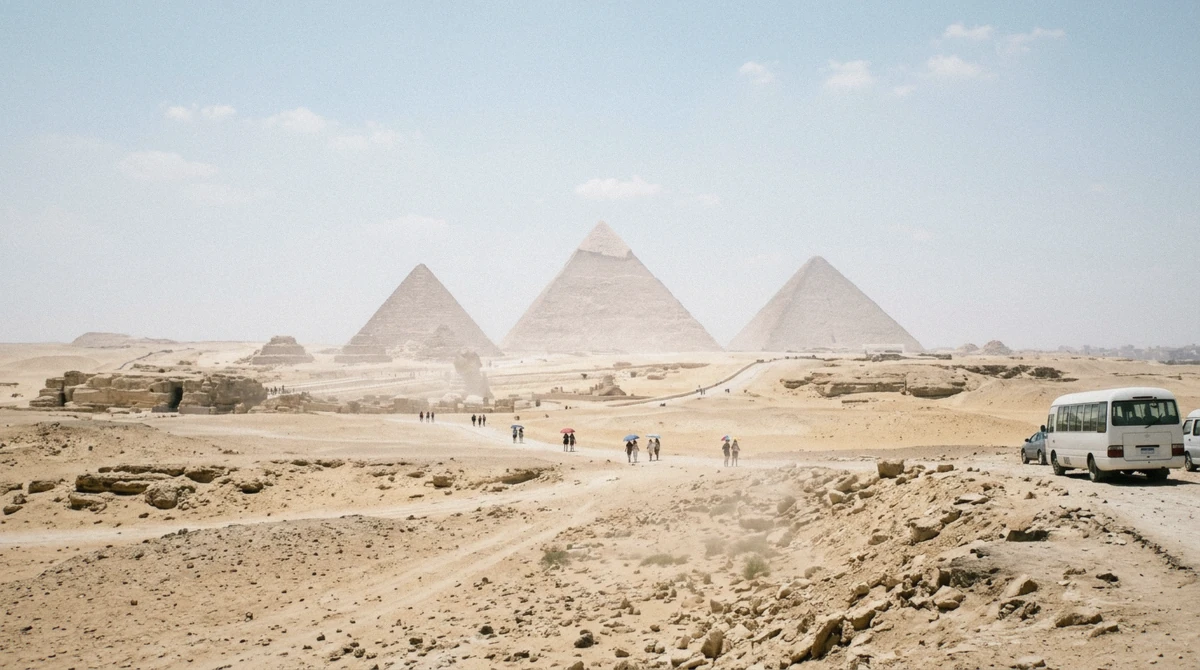
Midday in summer, the hardest hours on the plateau.
Season: winter wins
November to February are the comfortable months. Average highs run from 18.9°C in January to 24.9°C in November, and average lows fall to between 10.1°C and 15.6°C. Walking between the Great Pyramid of Khufu, the Pyramid of Khafre and the Great Sphinx is easy at those temperatures.
March, April and October are warm but workable, with average highs of 23.8°C, 28.1°C and 30.0°C. From May to September the average high sits between 32.2°C and 35.0°C, so a morning visit is the sensible plan. These are Cairo airport figures, the nearest long-term climate station to Giza.
Time of day: the opening hour is the coolest
The Giza Plateau opens every day at 07:00 with last entry at 16:00, in both summer and winter schedules. During Ramadan it opens at 08:00 with last entry at 15:30. The Ministry asks visitors to arrive at least one hour before closing.
The first three hours after opening, 07:00 to 10:00, give the coolest air and the longest shadows. Crowds also build later in the morning, so an early slot helps twice. A Giza Pyramids and Sphinx Tour with a Camel Ride can be booked for the morning, and the sunrise option is a 5-hour block built around that cool window.
Source: Egyptian Monuments Authority.
What Is the Giza Weather by Month?
Giza weather is mild and dry from November to March, hot from May to September, and peaks at an average high of 35.0°C in July.
The table uses the 1991-2020 climate normals for Cairo airport, the nearest long-term station. They are averages, not a forecast.
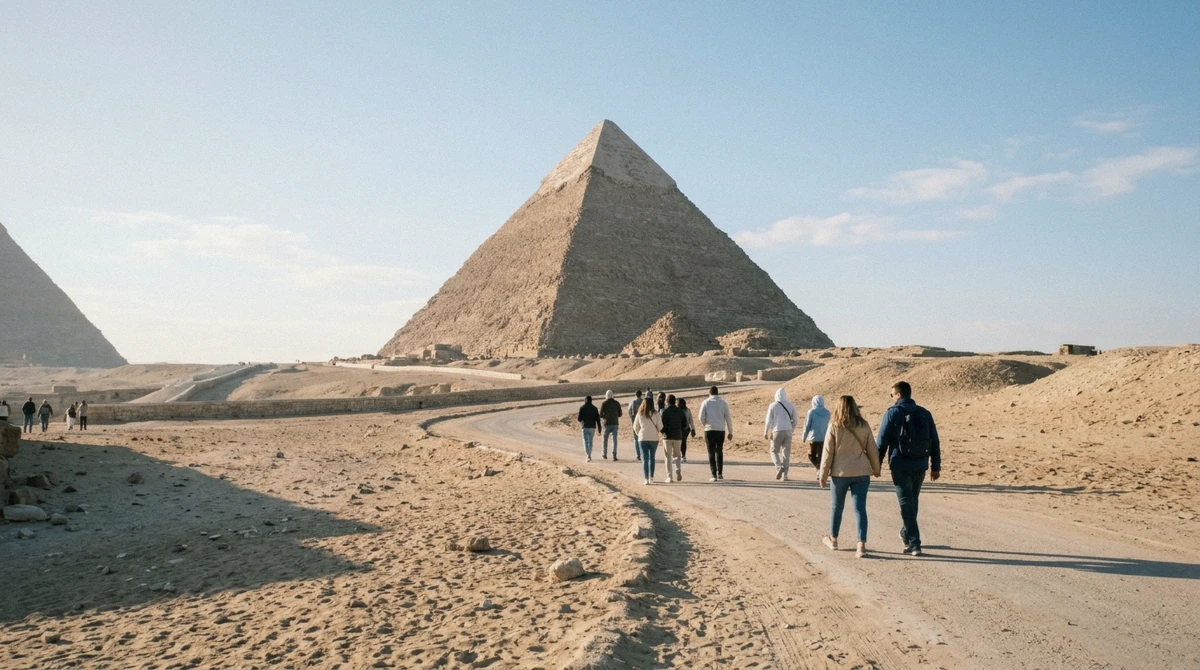
A winter morning on the Giza plateau.
Month by month for the plateau
Each row shows the average daytime high and night-time low in degrees Celsius from the Cairo airport normals, with what it means for a day at the pyramids. Use it to choose your month, then look at a short-range forecast a few days before you go.
| Month | Average high (°C) | Average low (°C) | What it means at the pyramids |
|---|---|---|---|
| January | 18.9 | 10.1 | Coolest month. Best for long walks, bring a jacket for the 07:00 opening |
| February | 20.5 | 11.0 | Mild days and cool starts, comfortable all day |
| March | 23.8 | 13.2 | Warm and pleasant, sunglasses help |
| April | 28.1 | 15.9 | Warming fast, start at 07:00 rather than late morning |
| May | 32.2 | 19.3 | Hot by midday, keep the plateau to the morning |
| June | 34.6 | 22.2 | Very hot, book a morning slot and move indoors at noon |
| July | 35.0 | 23.8 | Hottest month, an early start is essential |
| August | 34.9 | 24.3 | Same heat as July, carry water from the first minute |
| September | 33.4 | 22.7 | Still hot, only the first hours are comfortable |
| October | 30.0 | 20.0 | Cooling, late afternoons become workable |
| November | 24.9 | 15.6 | One of the best months for walking the plateau |
| December | 20.5 | 11.7 | Mild days, cool evenings, popular season so book early |
Tours That Fit
These tours suit the early-start advice above.

Giza Pyramids and Sphinx Private Tour with a Camel Ride
The classic half day, private: your own car, an Egyptologist, the plateau ticket already paid and a camel ride at the panorama point. Two shop stops are part of the day.
- Category
- Half day at Giza
- Cancellation
- Free cancellation 24h
- Operator
- Snefro Travel
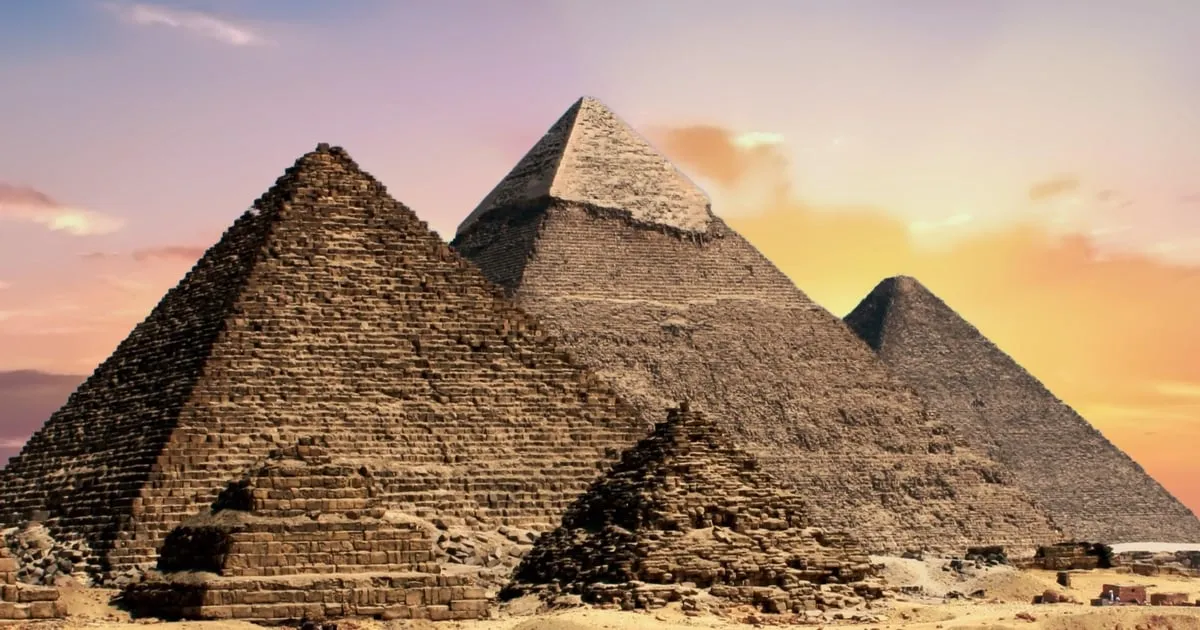
Giza Pyramids Sunrise Tour with a Camel Ride and Breakfast
A 5 am pickup and an hour on a camel or horse while the sun comes up behind the pyramids, then breakfast and two guided hours on the plateau before the heat.
- Category
- Half day at Giza
- Cancellation
- Free cancellation 24h
- Operator
- Egypt Excursions Online
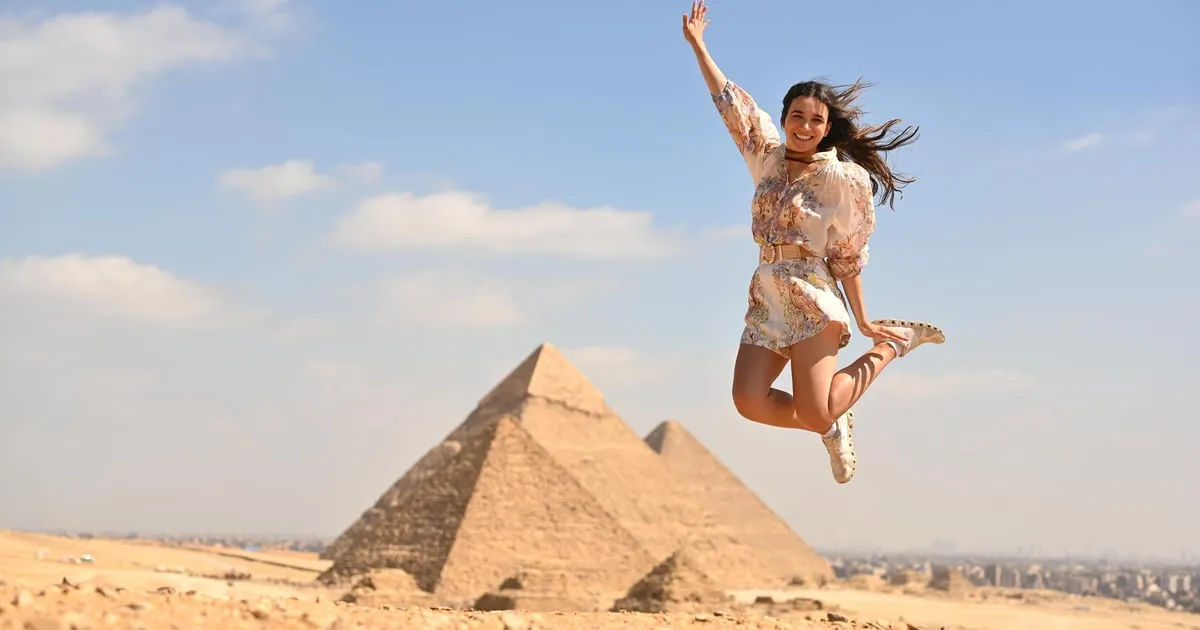
Giza Pyramids, Sphinx and Grand Egyptian Museum Tour with Lunch
Pyramids in the morning, two guided hours in the Grand Egyptian Museum after, both entry tickets and lunch in the price. Twelve people at most.
- Category
- Full day: Giza plus
- Cancellation
- Free cancellation 24h
- Operator
- OceanAir Travel
How Hot Is It at the Pyramids?
From May to September the average high is 32.2 to 35.0°C, and bare sand and limestone make the plateau feel hotter than the air reading.
There is no shade between the Great Pyramid and the Sphinx, so the sun matters as much as the number on the forecast.
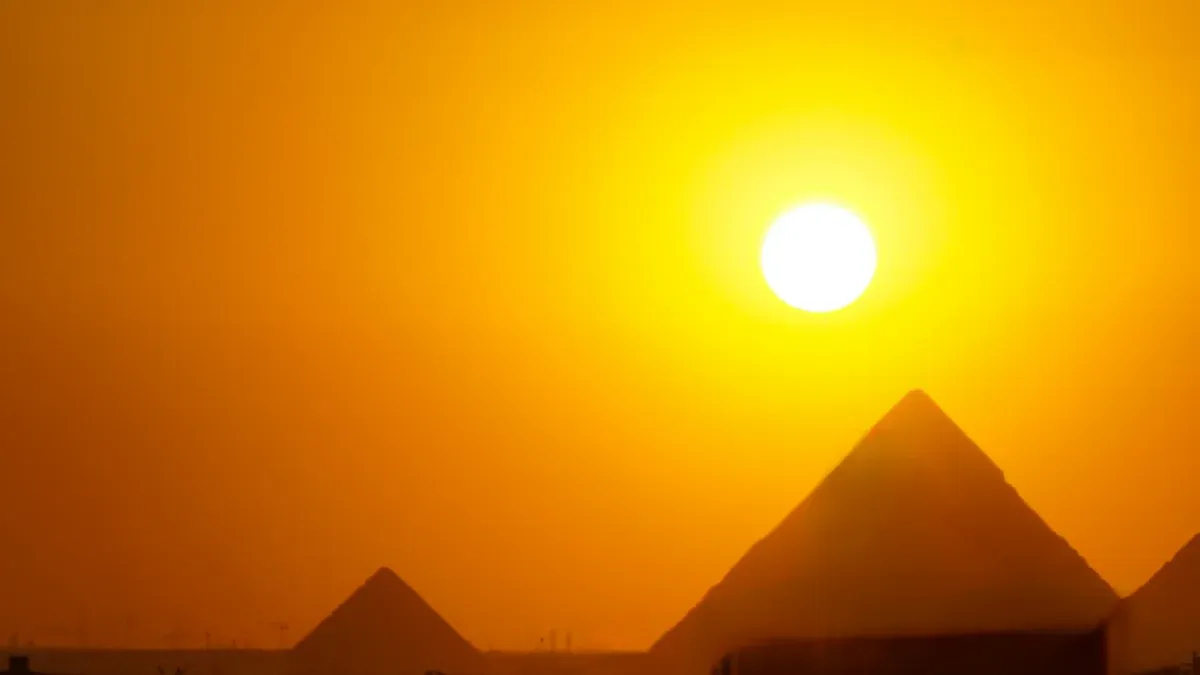
Sunset behind the pyramids. Photo: Spottedviper, CC BY-SA 4.0, via Wikimedia Commons
Why the plateau feels hotter than the forecast
July and August average 35.0°C and 34.9°C by day, with lows of 23.8°C and 24.3°C. Standing on open ground with no cover, treat the forecast high as a minimum. Carry water from the start and wear a hat.
Plan the hot months around the opening hour. The Giza Pyramids Quad Bike Desert Safari with an Optional Camel Ride lasts 1 to 2 hours, with 1 hour on the quad, so it fits a cool early slot. All our listed tours show free cancellation 24h, which lets you move a day if a heat spike appears in the forecast.
Is the heat bearable?
Yes, if you time it. From November to February the average high stays under 25°C and most visitors walk the plateau without trouble. From May to September it is bearable before midday.
After that, switch to something indoors. The Grand Egyptian Museum galleries are open 09:00 to 18:00 on Sunday, Monday, Tuesday, Thursday and Friday, and 09:00 to 21:00 on Wednesday and Saturday, with last entry one hour before the galleries close. The full-day Giza Pyramids, Sphinx and Grand Egyptian Museum Tour with Lunch is $97 per person and does exactly this.
Sources: Egyptian Monuments Authority, Grand Egyptian Museum.
Does It Get Cold in Giza?
Days stay mild all year, but December to February nights fall to an average of 10.1 to 11.7°C.
Cold is an early-morning and evening issue in Giza, not a daytime one.
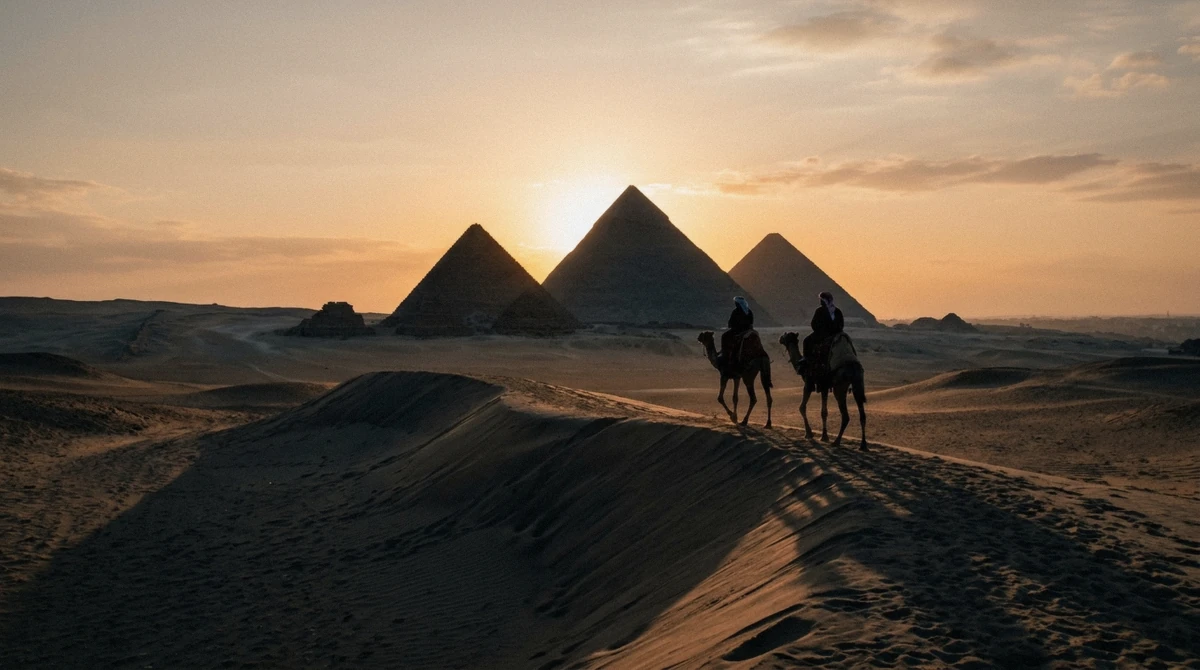
Sunrise on the desert ridge south of the pyramids.
Layering for a pyramid day
January has the lowest average night-time temperature at 10.1°C, followed by February at 11.0°C and December at 11.7°C. A light jacket is enough for the 07:00 opening. Take it off by mid-morning when highs reach 18.9 to 20.5°C.
If you plan to stay after dark, for example for the Pyramids Sound and Light Show, bring the jacket back out. Winter evenings at the plateau are far cooler than the afternoon.
If you are choosing between months, December is popular. Book your Pyramid of Giza tour early for the holiday weeks.
Source: Egyptian Monuments Authority.
How Hot Is It in Giza, Egypt Right Now?
This page shows monthly averages, so for a live reading use a forecast service a few days before your visit.
Live temperatures change by the hour, and a long-range forecast weeks ahead is not reliable.
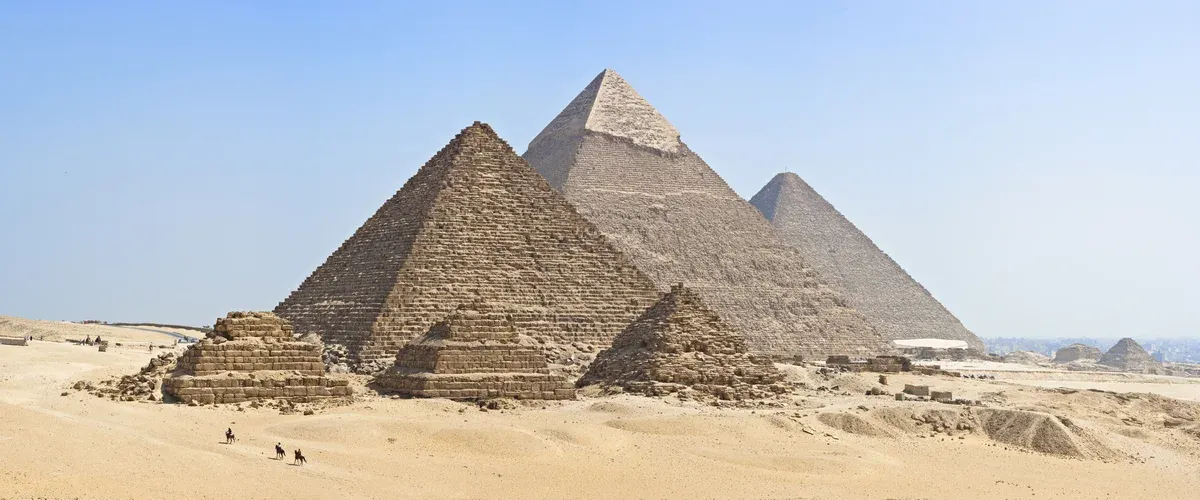
The three pyramids from the panorama viewpoint. Photo: KennyOMG, CC BY-SA 4.0, via Wikimedia Commons
Where to get the live reading
Pick your month from the table above, then check a short-range forecast such as AccuWeather for Giza or the Met Office forecast for the last few days before the visit.
Look at the hour-by-hour curve, not just the daily high. If the high is 30°C or more, book the 07:00 slot. If you have booked a tour with free cancellation 24h, you can still move the date the day before.
Source: Met Office.
How Does the Weather Change How You Plan a Pyramid Tour?
Heat decides the hour, the cool season decides the pace, and the Grand Egyptian Museum or the inside of a pyramid becomes the answer for hot afternoons.
Match the tour length to the season and you avoid the worst hours.
Match the tour to the season
The table compares what to book in each season, using the tour details and prices on this site.
| Season | Best choice | Why |
|---|---|---|
| November to February | Saqqara Tour from Cairo with Giza and Memphis, 8 hours, $73 | Cool enough for a full day outdoors |
| March, April, October | Giza Pyramids and Sphinx Tour with a Camel Ride, from $54 | Warm, so start at 07:00 |
| May to September | Giza Pyramids Sunrise Tour, 5 hours, $67 | Done before the heat |
Inside the pyramid and the plateau ticket
The plateau opens at 07:00 with last entry at 16:00. Foreign adults pay EGP 700 and foreign students EGP 350. Children under 6 enter free. Going inside the Great Pyramid of Khufu is a separate add-on at EGP 1,500 (about $27.09) for foreign adults, and the passage is tight and warm, so many visitors keep it for the cooler months or the first slot.
Tickets bought on egymonuments.com are non-refundable. If a heat spike is possible, a tour with free cancellation 24h gives you more room to change the day. The Private Giza Pyramids Tour with Entry Inside the Great Pyramid is listed from $15 per person.
Sources: Egyptian Monuments Authority, Egyptian Monuments Authority.
Giza Weather FAQ
What is the hottest month in Giza?
July, with an average high of 35.0°C and an average low of 23.8°C. See the Giza weather table for every month.
What is the coolest month in Giza?
January, with an average high of 18.9°C and a low of 10.1°C. A jacket helps at the 07:00 opening, and the Giza Pyramids and Sphinx Tour fits well.
Is Giza weather good in December?
Yes. December averages 20.5°C by day and 11.7°C at night, which suits long walks. It is popular, so book a pyramid of Giza tour early.
What is the best time of day to visit the Giza pyramids?
From the 07:00 opening to about 10:00. Last entry is 16:00, and the sunrise tour is built around the early window.
Does it rain at the pyramids?
The sources used for this page give temperatures only, so check a short-range forecast such as AccuWeather for Giza before you go.
Is there a train from Hurghada to Cairo?
This page does not cover trains. The listed option from Hurghada is the Hurghada to Cairo Day Trip by Road, $74 per person, 15 to 20 hours.
More Guides
- Cairo to Giza: How Far the Pyramids Are and How to Get There
The pyramids sit 13 to 15 km from central Cairo in 2027. The Line 2 metro takes 11 minutes. Compare every way across and see the prices.
- Giza Pyramids Facts: How Old, How Tall and Who Built Them
The pyramids were built between 2580 and 2500 BCE, over 4,500 years old. 2027 facts on age, height and builders. Compare tours.
- Great Pyramid of Giza: Height, Age and How to Visit It
The Great Pyramid stands 138.5 m tall, built for Khufu around 2600 BC. Entry needs a separate ticket. Compare tours in 2027.